

Description
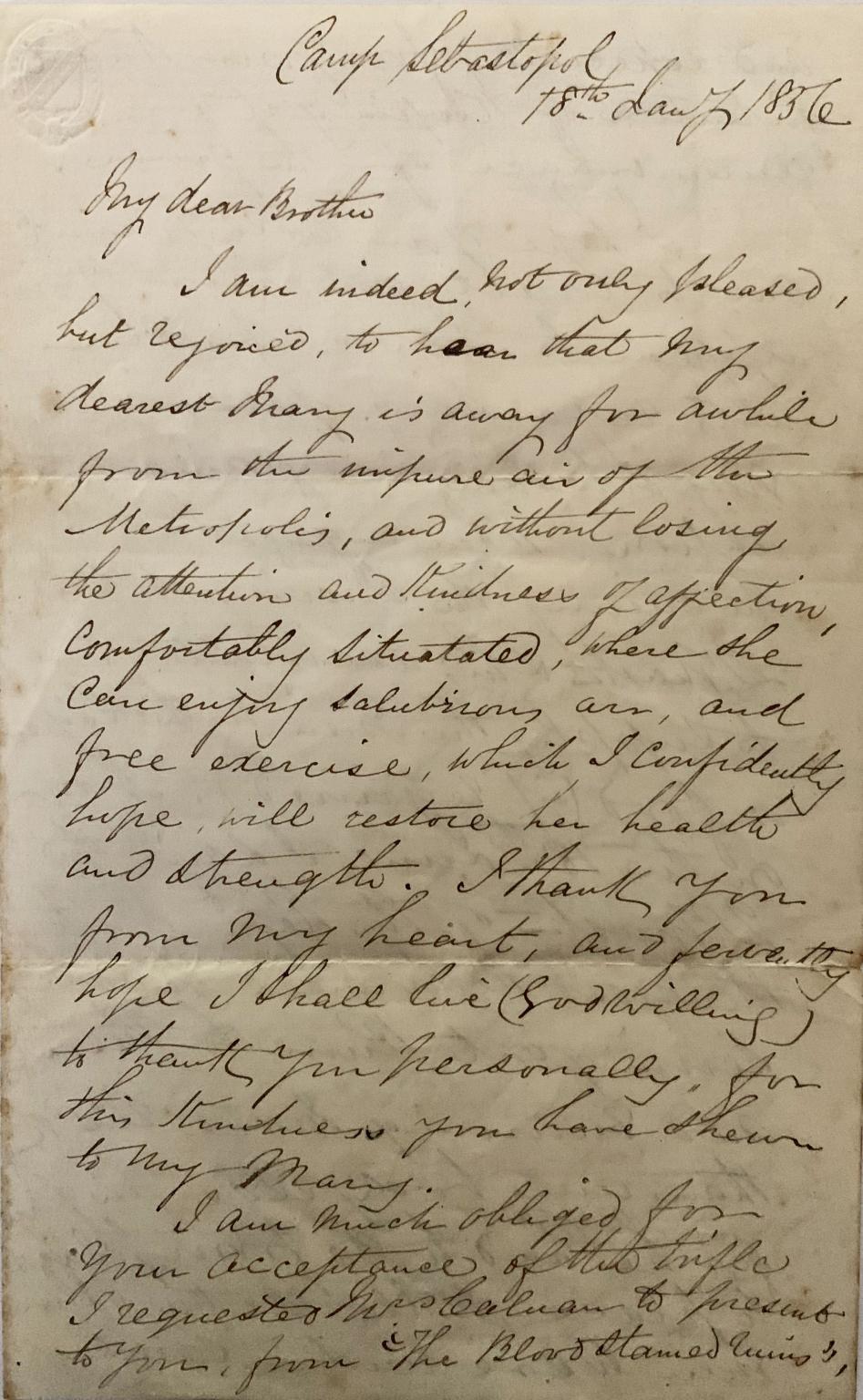
Three letters written by Sergeant Charles Calnan of the 18th (Royal Irish) Regiment to his brother from the siege lines at Sebastopol during the Crimean War. Charles Calnan was born in 1822 at Kinsale, County Cork. A clerk by trade – and hence a literate soldier – he enlisted in the 18th (Royal Irish) Regiment of Foot at Cork on 15 November 1841, serving 21 years and 6 days with the Regiment – of this, 17 years and 79 days were spent on overseas service campaigning in China, Bengal, Burma, The Crimea and Bombay and Madras during the Indian Mutiny. He was a sergeant at the time of the Crimea, but was promoted to Quartermaster Sergeant by the end of that campaign. He was discharged on 29 November 1862, thereafter residing at 24 Stafford Row, Bow, London. The three letters are marked as having been found in ‘Aunt Hetty’s belongings in 1961′. The second letter, dated 19 June 1855, contains a vivid description of the Battle of the Redan on 18 June 1855. “I have a sad tale to tell. On the very day I last wrote to you a shell fell in the midst of my poor company in the trenches blowing two men into a thousand pieces, depriving seven of their legs and sweeping the arms off six besides lesser wounds & strewing the ground for a radius of 100 yards around with blood pieces of hands, legs and arms, lumps of flesh and splinters of bones mingled with splinters of the men’s muskets.” The third letter, written the day after the fall of Sebastopol, appears incomplete but gives details of the strength of the Russian position, the power of the allies’ bombardment, the taking of the Malakov Redoubt by the French and his own promotion to Sergeant. In his official Regimental History of the 18th (Royal Irish), Gretton laments the loss of all contemporary accounts of the battle. ‘Thus,’ he writes, ‘the only accounts of the exploits of the Royal Irish on the 18th of June are to be found in a few statements, contributed by officers many years after the war was over, and in the dry official words announcing the bestowal of decorations.’ This is no longer the case; the uncovering of Sergeant Calnan’s letters provides us with a vivid and absolutely contemporaneous account.
- Catalogue number
- RHQ/2021/031
- Location
- RHQ